Nursesââ¬â¢ attitudes regarding continuing professional development in a district hospital of greece
Yfantis Aris
1RN, MSc, Laboratory cooperator, Nursing Department, TEI of Lamia
2Health Visitor , MSc, Laboratory cooperator, Nursing Department, TEI of Lamia
- *Corresponding Author:
- Yfantis Aris
Nafpaktou 19A
Pagrati PC 35100 Lamia
Tel: 2231032840
E-mail: aris_yfantis@yahoo.gr
Abstract
Aim : The aim of the present study was to evaluate the concept of Continuing Professional Development (CPD) in a provincial hospital and analyze whether the CPD can offer opportunities for Advanced Professional Development (APD) in nursing staff. Method and material: The study involved 23 clinical nurses of tertiary education employed in α provincial hospital. Collection of data was performed using postal questionnaire. Statistical analyses (descriptive) were conducted using the Statistical Package for Social Sciences 13.0 (SPSS, Chicago, Il, USA). Results: 43% of the participants were working in the sector of emergency incidents, 22% in the surgery clinic, 17% in the Intensive Care Unit and 9% in the Pathology and Cardiology clinic, respectively. 22% of the participants had not participated in any kind of postgraduate training programmes, 30% had attended two programmes and the largest percentage of 48% had attended only one programme. 30% of the CPD activity took place in hospital and 70% in Centres for Vocational Training. Regarding the benefits of CPD, 82.6% of the participants answered that CPD helped them to plan their nursing care, whereas 17.4% that CPD helped them to thing about what to do in practice. 78% of the participants reported the existence of barriers to CPD. Regarding difficulties to attend the CPD activity, 17% reported that were unable to attend it because the clinic was too busy, while 83% reported difficulty because the CPD programme was already booked. Conclusion: Nurses appeared to understand the concept of CPD as a part of lifelong learning and faced difficulties to measure the effectiveness of CPD in use when dealing with a range of issues. The study findings confirm that CPD remains a major issue for clinical nurses in Greece, providing opportunities for advanced professional development. The study findings should help those proving the CPD to plan more effectively and have implications for staff requirements and retention.
Keywords
Continuing Professional Development, opportunities, health professionals, development
Introduction
Patient expectations for high quality health care services lead health providers to improve the educational status of health professionals in order to meet these expectations. Continuing Professional Development (CPD) is considered as the systematic maintenance, improvement and broadening of knowledge and skills, and the development of personal qualities necessary for execution of professional, technical duties throughout the individual’s working life [1]. According to the literature, during the process of continuing professional development individuals take control of their own learning and development, by engaging in an on-going process of reflection and action. On the other hand CPD is based not only on the needs of the individual but also on the employer needs as well as the profession as a whole and society [2,3].
CPD as a subset of lifelong learning is gaining increasing recognition in both its’ personal and professional applications. It is widely viewed as playing a pivotal role in meeting health service delivery needs and the learning needs of individual healthcare professionals [4,5]. However, many nurses encounter difficulties in gaining access to CPD, and those opportunities for CPD that are provided may be restricted to traditional methods such as formal academic programmes. In a national study of turnover in nursing and midwifery in the University College Cork (National University of Ireland), McGarthy et al., [6] found that a little more than half of the respondents (53%) reported experiencing some form of CPD, typically in the form of in service education (25%) and study days/seminars (28%), with fewer respondents reporting having access to study leave (12%) and financial support (10%). The authors conclude that large numbers of nursing staff do not have access to professional updating.
In Greece, during the last decade, training programmes have increased dramatically, mainly due to significant funding from the European Union. However, the country was ill prepared for such a large-scale venture. As a result, shortcomings in the quality and organization of training programmes were unavoidable. Nevertheless, some important steps towards the modernization of the field have indeed been made [7]. The Labour Force Employment Organisation (OAED), Centres for Vocational Training (KEK) and Education Departments of various Ministries are the bodies that promote lifelong professional education. The Labour Force Employment Organisation (OAED) implements continuing vocational training courses seeking to cover the needs of the unemployed who require specialisation in order to find work, as well as the needs of the employees, where acquiring extra skills will facilitate their career development. Centres for Vocational Training (KEK) are private sector bodies (for-profit or not-for-profit) or public bodies providing continuing training which have received positive evaluation and have been certified by the National Accreditation Centre (EKEPIS) and have secured financing from national (Ministry of Labour) and community resources (European Social Fund and European Regional Development Fund). The KEK plan, organise and run continuing vocational training courses for employees and the unemployed, graduates from all levels of education, in various subject areas. The Education Departments of various Ministries also plan vocational training programmes both for the unemployed and the in-house employees. The Ministry of Health and Welfare provides vocational education and training courses in all areas of specialisation in the health sector for the unemployed and the employees in the National Health System, at its 32 continuing vocational training centres within hospitals of the National Health System and the National Ambulance Service [8].
In Lamia’s hospital only two programmes were established. These were the basic support and automatic defibrillation and the Provision of nursing treatment in Emergency Department. The hospital of Lamia is in the centre of Greece and has about 300 beds. Many of these beds accommodate accident and emergency cases, as it is the only hospital in the town (population approximately 70.000). This situation enhances the importance of better health care, good management and high-speed services. These needs require that the nursing staff has the appropriate experience and are able to identify their learning needs and finally plan their work effectively.
The aim of the study was to evaluate the concept of Continuing Professional Development (CPD) in the hospital of Lamia and analyze whether the CPD can offer opportunities for Advanced Professional Development (APD) in the nursing staff.
Material and Method
Collection of data was performed using postal closed –type questionnaires, which were designed according to the literature review and the objectives. This procedure was chosen mainly because of the cyclical shifts of the nurses and the followed difficulty to find the appropriate date to distribute the questionnaires. On the other hand, choosing this kind of questionnaire as Oppenheim [9] suggests, would benefit the researcher through firstly, low cost of data collection and secondly low cost of processing. This approach therefore was a lot less time-consuming for the researcher than interviewing.
The questionnaire was anonymous so as to reduce or eliminate bias. Moreover a reasonable date for the return inside of the letter which had been addressed with stamped was given, thus reducing the possibilities of non-response of the questionnaires. The choice of answers was created in accordance with DΥ.PΕ (is the responsible authority in Lamia), which organized the programmes/seminars) which informed the author of CPD programmes for that particular area and period
Participants were questioned about the definition of CPD, the role of CPD in their clinical area, effectiveness and benefit of CPD, any CPD programmes established in their hospital and the CPD programmes they attended. The survey took place in August 2007.
Distribution of questionnaires: Access to staff nurses was sought by phone contact to the hospital manager. The manager was asked for permission to access their staff and was invited to nominate a link person (nurse leader) for the purposes of distribution of the questionnaires. This was in order to calculate the potential total numbers of staff who might be invited to participate in the survey. Staff nurses were invited to participate. Nurses who had qualified from cities, towns and rural areas and were working in Lamia’s hospital were represented. In total 56 questionnaires were distributed, of which 23 were returned, giving a response rate of 41%. The data was analyzed using Excel, 2003 v.
Ethical considerations: The study had to provide definite assurances about participant’s anonymity and data confidentially The first step was to approach the manager and asked for permission to access their staff and was invited to nominate a link person (nurse leader) for the purposes of distribution of the questionnaires. Secondly, the questionnaire was anonymous so as to reduce or eliminate bias. Questions which asked from the participants to criticize their colleagues or the leader because may be reluctant to say something bad or not be objective in their comments which would cause biased results were excluded.
Results
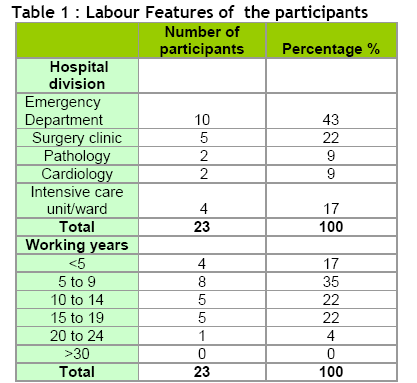
The whole sample population were women. Regarding years of working experience, 35% of the nurses (8) had been working for 5-9 years, 22% for 10-14 years and 17% less than five years and finally the smallest group 4% (one person only) had been working for 22 years.
Αccording to the place of graduation, 65% were graduates of Technological Institution in Lamia, 22% of Technological Institution in Athens and 13% nurses in Thessalonica. 43% of the participants were working in the sector of emergency incidents, 22% in surgery clinic, 17% in the Intensive care ward and 9% in the Pathology and the Cardiology clinic, respectively. (Table 1).
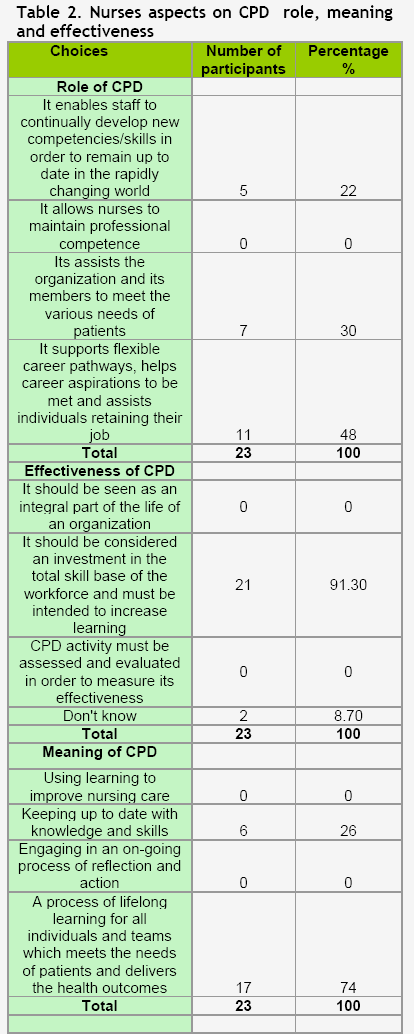
Regarding the role and meaning of CPD, 74% of the participants reported that CPD is a process of lifelong learning for all individuals and teams which meets the needs of patients and delivers the health outcomes. On the other hand, 26% of the sample answered that CPD can be recognised by keeping up to date with knowledge and skills. A small percentage of 22% answered that CPD role is to enable staff to continually develop new competencies/skills in order to remain up to date in the rapidly changing world. The other choice that was answered by a larger number of participants than the first one, which covered the 30% of the sample found that the role of CPD is to assist the organization and its members to meet the various needs of patients. Finally the greatest number of respondents 48% answered that CPD supports flexible career pathways, helps career aspirations to be met and assists individuals retaining their job .The respondents were given three possible answers to choose from as well as the freedom to choose more than one answers in the section of effectiveness. More than 90% preferred to tick all three answers. (Table 2).
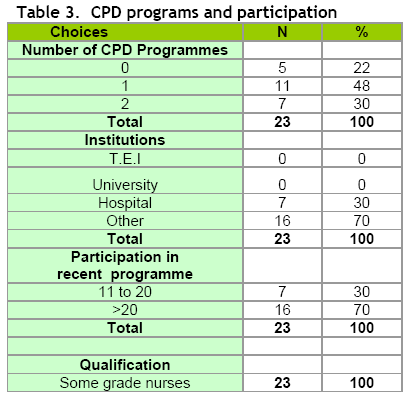
When respondents were asked whether they attended any CPD programme in the last two years, they had to make a choice of seven different answers.. From the sample of the present study investigated, 22% had not received any kind of programmes, 30% had attended two programmes and the largest percentage of 48% had attended only one programme. 30 % of CPD activity took place in hospital and 70% in Centres for Vocational Training. A relatively large number of respondents, almost 70% Stated that this CPD activity included a group of more than 20 participants. The rest 30% indicated that the programme had been attended by 11-20 people. The respondents answered 100% that this activity had been attended mostly by nurses of the same grade.(Table 3).
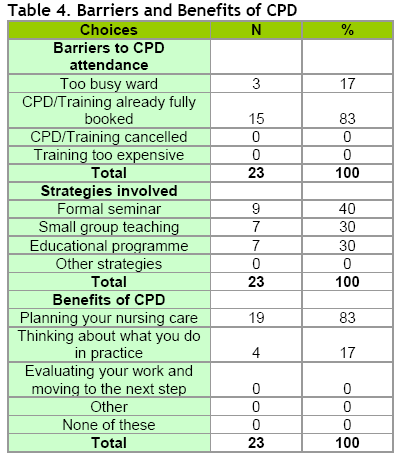
Regarding the benefits of CPD, 82.6% (19) answered that CPD helped to plan their nursing care and 17.4% (4) answered that CPD helped them to thing about what to do in practice. As for barriers to CPD, a large number of the participants 78% answered ‘yes’ and 22% ‘no’. From the people that the answer was ‘yes’, 17% gave the reason that were unable to attend the CPD activity, because the clinic was too busy in order to attend and the other percentage 83% found difficulty because the CPD programme was already booked. As for the strategies involved, some nurses (40%) answered that the CPD activity took place in a seminar form and the other two choices included small group teaching and educational programmes accumulated which 30% each. (Table 4).
When participants were asked if they find support in applying the acquired knowledge, 91% answered that they did not find support, whereas 9% answered that they did. Regarding the item : “Have you had any formal training such as a course or workshop since you qualified in any of the following?” All the respondents answered ‘no’. In the Question :“Was time away from the work place allocated for you to attend the CPD?” 83% of the participants answered ‘no’.
Discussion
According to the results of the present study, the majority of the participants were working in emergency department, secondly came the surgery clinic, then the Intensive care ward and finally the Pathology and the Cardiology clinics. Trying to interpret these results, one can assume that these clinics need good management and high-speed services. These needs require that the nursing staff are highly educated, have the appropriate experience, are able to identify their learning needs and finally plan their work effectively, in accordance with CPD objectives [10].
Continuous professional development (CPD) is essential in modern day nursing and it is not restricted simply to lifelong learning. Nonetheless, most respondents appeared to understand the concept as a part of lifelong learning and not as an on-going process of reflection and action [2]. A possible explanation for this finding is that This probably happened because of the lack of expert nurses on CPD. The programmes that are taking place in hospitals usually focus on general nursing subjects between nurses and patients. However, in practice disciplines, such as nursing, learning can be maximised through experience located in the clinical setting. Feedback and “moving to the next step” are essential in this process and experiences in 'real-life' settings need to be effectively facilitated to obtain the desired outcomes [11,12].
In the question that asked the participants to find ways to approach the effectiveness of CPD, four possible answers were given to choose from, as well as the freedom to choose more than one answers. This seemed to be convenient for them since a rate of more than 90% preferred to tick all three answers. From this rate of response it could be suggested that their knowledge about the means of measuring CPD effectiveness was very limited which as a result this pushed them to this multiple choice. One possible explanation for this finding is that since the programmes are new the nurses cannot measure the effectiveness, as they do not have previous experience. Another possible explanation is that they did not use portfolios which CPD suggests as a useful tool in order to transfer the learning outcomes in daily clinical practise. The literature provides positive indications for portfolio use in CPD in nursing. Much discussion surrounds the use of the portfolio as an assessment tool in pre-registration/undergraduate nursing education programmes [13-16].
When respondents were asked whether they attended any CPD programme in the last two years, they had to make a choice of seven different answers. According to the results of the study, 21.7% had not received any kind of programmes, 30.4% had attended two programmes and the largest percentage of 47.8% had attended only one programme. This is entirely different from abroad, where CPD programmes are a incorporated in continuous nursing education [7]. This finding could also mean that their perception around the definition of CPD is limited within the boundaries of improving the service towards the patients rather than improving their competences.
Of the results of this study, it was also found that CPD had beneficial effects in planning the nursing care and thinking what to do in practice. On the contrary, choices such as “evaluating your work” and “moving to the next step” or something else were avoided. Lifelong learning is a requirement for all nurses. Structured continuing education programs are just one method of acquiring knowledge. Non-structured, self-directed methods of development often are overlooked in this process. This study indicates that RNs need a stimulating work environment, including mentoring and support to enable continuous professional development in health care. On the other hand, Gould et al., [10] stated that CPD remains a major issue for clinical managers in the United Kingdom and that providing opportunities for such development may be an important factor in enhancing job satisfaction. According to Magginson and Whitaker2 individuals through CPD activities gain experience based on curiosity and the questioning of various issues that assist in opportunity spotting. Furthermore individuals are motivated through the constant development of new skills and become more focused and productive. Patients on the other hand are benefited because CPD helps nurses to respond better to their needs and offer a high quality service [17,18].
Un regard to barriers in attending a CPD programme, participants reported that “ busy clinic” and a “fully booked programme” were the most significant. It is worth mentioning that a small number of programmes are taking place and the number of participants in each seminar is limited. More in detail, there are 86 TE nurses in the hospital and the seminar accepts only 20. Moreover within this number of 20 are usually included nurses of University Education, health visitors, physiotherapists and doctors. Thus, there is a need for the government to organize more educational programmes in order all health professionals have the chance to attend such seminars/programmes. In other countries there are certain regulatory bodies acting as a means for nurses to demonstrate continuous learning and professional growth. These organizations assist nursing leaders, practitioners, educators, and regulators to successfully design and implement a comprehensive program to enhance competence and continued professional growth in an environment of change and challenge [19,20].
On the other hand, many clinics are always busy and it is difficult from the nurse leader to allow the nursing staff to attend the programmes. A recent study revealed that nearly 47% of the Fellows of the Australasian College for Emergency Medicine nominated lack of time as a significant barrier to attend a CPD, whilst 35% reported family commitments preventing CPD [21]. Professional knowledge was reported as the prime motivator to seek CPD. Other motivators, which featured in the top four most important factors included updating existing qualifications, increasing the status of the profession as a whole and demonstrating that an individual was professionally competent [22].
Regarding the support they get when applying their learning from a CPD programme in practice within their clinic, the majority of participants (91%) answered ‘no’, whereas 9% answered ‘yes’. Additionally, the group that tick the box ‘yes’ reported that they found support only from the nurse leader achieving 100% and leaving the other choices which were colleagues and doctors without choosing. This means that the first group who answered ‘no’ probably had approached staff members who were either unaware or did not have time to spare. One more reason is that the programmes/seminars taking place in the form of lectures and not in the clinic, which means that nurses cannot find support when face barriers or problems in clinical practise. In practice disciplines, such as nursing, learning can be maximised through experience located in the clinical setting. Theoretical knowledge or knowledge that has previously been 'distal' to practice could be integrated into immediate practice via mutual collaboration of nursing team members [11,23].
Bibliography
- Morgan A, Cullinane J, Pye M. Continuing Professional Development: rhetoric and practice in the NHS .Journal of education and work. 2008;21:233-248.
- Magginson D, Whitaker V. Continuing professional development. London: Cipd, 2003.
- Madden C, Mitchell V. Professional standards and competence. A survey of continuing professional education for the professions. Bristol: University of Bristol, Department of continuing education. 1993.
- DiMauro NM. Continuous professional development. J ContinEducNurs. 2000;31:59-62.
- Arcand LL, Neumann JA. Nursing competency assessment across the continuum of care. J ContinEducNurs. 2005;36(6):247-54 .
- McCarth G, Tyrrell M, Croni C. National study of turnover in nursing and midwifery, department of nursing. University College Cork: National University of Ireland, 2002.
- Organization for Economic Co-Operation and Development The role of national qualification systems in promoting lifelong learning - Greece. 2003. Available : https://www.oecd.org/
- Lanara VA. Continuing education in Greece. Nursing Times. 1994;88:38-39.
- Oppenheim A. Questionnaire design, interviewing and attitude measurement. New ed. Pinter Publishers Ltd, London 1992.
- Gould D, Daniel K, Len G, Maidwell A. The changing training needs of clinical nurse managers: exploring issues for continuing professional development. J AdvNurs. 2001;34(1):7-17.
- Henderson A, Winch S, Heel A. Partner, Learn, Progress: a conceptual model for continuous clinical education. Nurse Educ Today. 2006;26(2):104-9.
- Arcand LL, Neumann JA. Nursing competency assessment across the continuum of care. J ContinEducNurs. 2005;36(6):247-54.
- Gannon F, Draper P, Watson R, Proctor S. “Putting portfolios in their place”. NursEduc Today. 2001;21(7): 534-40.
- Alexander J, Craft S , Baldwin M., Beers G. The nursing portfolio: a reflection of a professional’. J ContinEducNurs. 2002;33(2): 55-9.
- McMullan M, Endacott R, Gray M. ?Portfolio and assessment of competence a review of the literature?. J AdvNurs. 2003;41(3): 283-94.
- Storey L. The concept of competence, assessment of competence conference proceedings. Dublin: AnBordAltranais, 2001.
- Danielson E, Berntsson L. Registered nurses' perceptions of educationalpreparation for professional work and development in their profession. Nurse Educ Today. 2007;27(8):900-8.
- Health Service Circular.Continuing professional development: quality in the new NHS.1999.https://www.dh.gov.uk/assetRoot/04/01/20/90/04012090.pdf.
- Campbell B, Mackay G. Continuing competence: an Ontario nursing regulatory program that supports nurses and employers. NursAdm Q. 2001;25(2):22-30.
- Forbes A, While A, Ullman R. Learning needs analysis: the development of a tool to support the on-going professional development of multiple sclerosis specialist nurses. Nurse Educ Today. 2006;26(1):78-86.
- Dent AW, Weiland TJ, Paltridge D. Australasian emergency physicians: a learning and educational needs analysis. Part five: barriers to CPD experienced by FACEM, and attitudes to the ACEM MOPS programme. Emerg Med Australas. 2008; 20(4):347-56.
- Ryan J. Continuous professional development along the continuum of lifelong learning. Nurse Educ Today. 2003;23(7):498-508.
- Howarth M, Holland K, Grant MJ. Education needs for integrated care: a literature review. J Adv Nurs.2006;56(2):144-56.

Open Access Journals
- Aquaculture & Veterinary Science
- Chemistry & Chemical Sciences
- Clinical Sciences
- Engineering
- General Science
- Genetics & Molecular Biology
- Health Care & Nursing
- Immunology & Microbiology
- Materials Science
- Mathematics & Physics
- Medical Sciences
- Neurology & Psychiatry
- Oncology & Cancer Science
- Pharmaceutical Sciences